
Regulation
The EU data-centre label: what “waste heat reuse ready” means for your site
The Commission adopted the EU rating scheme for data centres on 21 September 2026; it enters into force after the European Parliament and Council scrutiny period and publication in the Official Journal. Every rated data centre's label will show a yes/no for waste heat reuse readiness, and data centres under construction can join with their expected values.
- delegated regulation adopted by the Commission
- 21 Sep 2026delegated regulation adopted by the Commission
- first labels due, then yearly
- 15 Aug 2027first labels due, then yearly
- “waste heat reuse ready” shown on the label
- Yes / No“waste heat reuse ready” shown on the label
- Commission review
- 31 Dec 2028Commission review
On the label
What the label shows
Every reporting data centre gets this electronic label from the European database, every year, in all EU languages. The amount of heat actually reused (ERF) is not on the label: it is published only as national and EU averages.
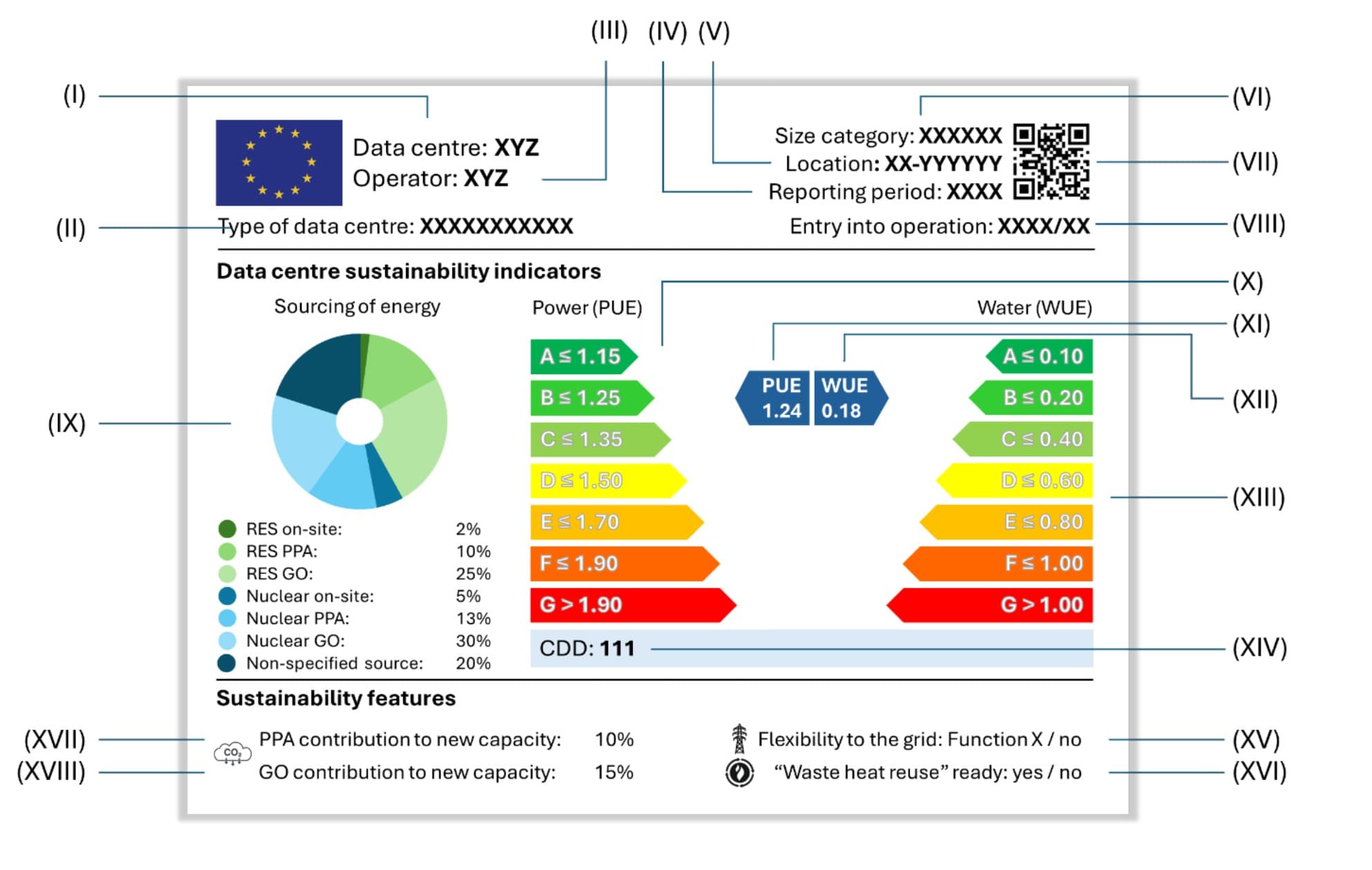
- Identity
- Name, operator, type, size category, location, reporting period, entry into operation and a QR code to the EU database.
- Sourcing of energy
- Shares of renewable and nuclear energy (on-site, PPA, guarantees of origin) and of non-specified sources.
- PUE class
- Energy efficiency from A (PUE ≤ 1.15) to G (PUE > 1.90).
- WUE class
- Freshwater use per IT kWh, from A (≤ 0.10) to G (> 1.00).
- Cooling degree days
- The local climate, so PUE values can be compared fairly.
- New capacity
- How much of the PPAs and guarantees of origin come from assets built or refurbished in the last 10 years.
- Flexibility to the grid
- Which grid flexibility function the site provides, or none.
- Waste heat reuse ready
- Yes / no: the one heat item on the label.
Definition
“Waste heat reuse ready”, in the rule's own terms
A data centre designed or retrofitted to capture and provide waste heat to external users at its boundary, including heat exchangers, dedicated hydraulic loops and thermal metering, regardless of whether a heat network or heat pumps exist yet.
That is exactly the tie-in the Heat Hub provides at the data centre's boundary.
Key points
Facts every operator should know
Only about 1.8% is reused today
In the first EED Article 12 report (21 September 2026), 770 EU data centres reported 68 TWh of electricity use in 2024, rising to 114 TWh by 2030; only 67 of them reused heat, about 1.8% of the total. The barriers named are missing nearby offtakers, costly transfer infrastructure and seasonal mismatch: the three things a Heat Hub next door is built to solve.
Binding floors are next
The Commission is consulting until 14 December 2026 on minimum performance standards for new and retrofitted data centres, covering energy, water, waste heat reuse and grid services, with a proposal due in the second quarter of 2027. The Parliament's objection deadline for the rating act is 21 January 2027.
France sets a number
France's Decree 2025-1382 (29 December 2025) requires data centres of 1 MW or more to recover their waste heat; a site is deemed to use it effectively at an energy reuse factor of 0.20 or higher, with exemptions where technical or economic constraints make that impractical.
Heat-upgrade energy is subtracted
Electricity used in technologies that raise the temperature of heat that is then reused (heat pumps, boosters, heat transformers, heat exchangers, heat-network equipment) is subtracted from the data centre's total energy, so it does not worsen PUE.
Design values count
Data centres not yet in operation may join voluntarily with the values they are designed or expected to achieve after two years of operation, so a new build can plan for "reuse ready" from the start.
Data must hold up
Reported data must come from reliable, accurate and reproducible methods, and data centres now report whether their data is certified, and whether by themselves or by a third party.
Wider use across EU law
The rating will be used to assess data-centre sustainability in other EU laws, including the proposed Cloud and AI Development Act.
EU Code of Conduct
The JRC 2025 best practices expect new builds and retrofits to evaluate waste heat reuse, and name hydroponic farming, fish farms and grain and biomass drying as uses.
Germany goes further
Germany's Energy Efficiency Act (EnEfG) requires data centres of at least 300 kW entering operation from 1 July 2026 to reuse at least 10% of their energy, rising to 15% from 1 July 2027 and 20% from 1 July 2028. An amendment (first reading in the Bundestag on 24 September 2026) keeps the percentages but exempts sites with no viable heat-network connection, after a cost-benefit analysis.
What it means for Avans projects
How the Avans model fits the rules
One point for everything
The Heat Hub's tie-in sits on the data centre's side of the boundary: the handover flange, the regulatory boundary and the heat meter are the same point.
The operator gets the benefit
The site's Heat Hub project company owns the tie-in; the contract makes it part of the operator's heat-extraction infrastructure, with full data access.
Only used heat is reported
No heat is dumped on the Hub side, so every reported MWh of reuse is heat actually used.
Separate energy accounts
The Hub has its own electricity and water connections, so it never counts in the data centre's energy or water figures.
Sources: Commission Delegated Regulation C(2026) 3472 final of 21 September 2026 on a common Union rating scheme for data centres (two-month scrutiny by Parliament and Council; enters into force 20 days after publication in the Official Journal, not yet published); JRC, 2025 Best Practice Guidelines for the EU Code of Conduct on Data Centre Energy Efficiency; German Energy Efficiency Act (EnEfG).
Next step
Get reuse-ready before the first label.
We'll check your cooling concept against the definition and show what it takes to answer “yes”.
What happens next
- 1A 30-minute call: heat, possible users, timeline
- 2Together we check fit, schedule and funding options
- 3You get a fixed-price pre-study proposal, credited against the system delivery